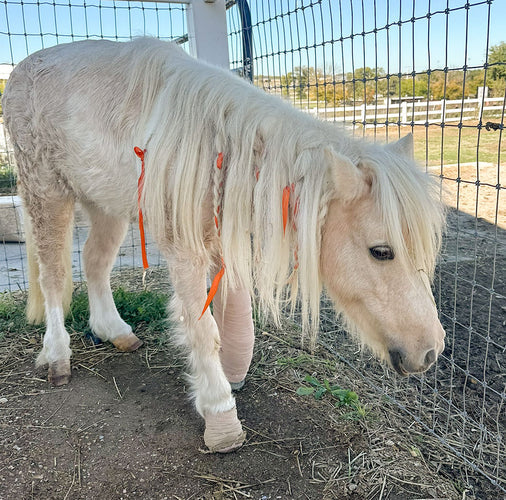
One evening, Hercules began to colic, and pain medicine wasn’t helping. We rushed him to the hospital immediately to ensure he got the care he needed.
 Normal Tests, But a Concerning Reflux
His bloodwork and ultrasound came back normal, which was reassuring. However, the vets found a significant amount of reflux.
What does that mean? Horses physically cannot vomit. When fluid builds up in their stomach, it has nowhere to go. To relieve the pressure, vets pass a tube through his nose into his stomach to drain the fluid—essentially “throwing up” for him and preventing further complications.
We don’t yet know what’s causing the reflux. Hercules was admitted to the hospital, where he’ll have the tube passed periodically overnight while the vets monitor him and determine next steps.
Even with the unknowns, we’re comforted knowing he’s in the best possible hands.
A Steady Morning
The next morning, Hercules was doing okay—not better or worse. He was refluxing less but still a notable amount, though he remained comfortable.
A Fever Brings New Concerns
Sunday looked promising; Hercules was even preparing to come home. But then he developed a fever, and by Monday, he was moved to the isolation unit due to a fever of unknown origin.
The isolation unit is for horses who may be contagious. They follow strict quarantine protocols—which, in fact, is where we learned how to run our sanctuary’s isolation procedures!
Infection on the Horizon

Hercules’ bloodwork revealed an infection: his SAA jumped from 13 to 2800, and his white blood cell count was rising. The good news: his kidneys are healthy, and his lungs are clear—no signs of pneumonia.
The current working diagnosis is Strangles, likely related to his exposure to Reilly, who tested positive, both at the rescue barn and during transport.
Because Hercules had recently been on antibiotics for his eye, the typical Strangles signs (fever, nasal discharge, abscesses) may have been temporarily masked. In most cases, Strangles is allowed to run its course with supportive care, unless complications arise.
Keeping a Close Eye
Hercules will have repeat bloodwork over the next few days, and we’re monitoring his SAA and white blood cell count closely. There’s a specific test for Strangles, but it’s most accurate a few days after symptoms appear.
Stoic, Eating, and Well-Loved
Through it all, Hercules remains bright and eating well. He’s a stoic guy, but the team at Weems is giving him all the love, attention, and care he deserves.
Even in the face of uncertainty, we’re grateful Hercules is surrounded by the best care—and we’ll keep you updated on his journey back to full health!